
Open this AI tool now
https://github.com/yoheinakajima/babyagiThe Architecture of Baby AGI: From Task Planning to Self-Assembly
Baby AGI is an experimental Python framework designed to build autonomous agents that can construct and expand their own capabilities. It registers modular functions, tracks dependencies across an execution graph, and runs them from a central database alongside a dedicated web dashboard.
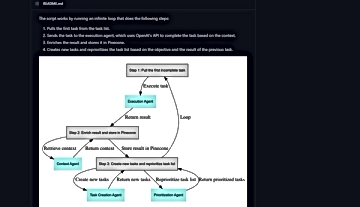
Created by Yohei Nakajima, the project originally gained prominence in March 2023 by demonstrating automated task planning through large language models. That first version solved goal-driven workflows by chaining task creation, prioritization, and execution into an autonomous loop. In September 2024, the maintainer archived that original task-planning architecture into a separate snapshot repository to reset the framework around self-assembling code.
Tired of juggling ten tabs? ToolSuite bundles the AI workflow tools power users rely on — in one place.
Try ToolSuite NowThe current iteration operates on the premise that the most effective path toward general autonomous intelligence is building the simplest possible system capable of constructing itself. Rather than following static prompts, the architecture leverages adaptive learning algorithms and natural language processing to simulate human perception evolution. This approach emphasizes generalization and transfer learning, helping the software apply acquired skills to unfamiliar operational challenges.
Managing Dynamic Code with the Baby AGI Functionz Engine
At the foundation of the rebuilt framework sits functionz, an execution engine that stores, manages, and executes Python functions directly from a database. Instead of importing static script files, the agent treats individual coding functions as database records that can be modified, linked, or loaded dynamically.
The functionz system structures code relationships as a directed graph. This design ensures that agent operations remain observable, reproducible, and strictly sequenced. When a routine registers with the engine, it declares three primary operational properties:
- External Imports: Third-party Python libraries such as mathematical utilities that the routine must load before evaluation.
- Internal Dependencies: Named references to other stored functions that must execute first to provide prerequisite inputs.
- Key Dependencies: Specific authentication credentials and API keys, such as OpenAI secrets, required to invoke underlying language models.
Automatic execution logging accompanies every routine managed by the engine. This logging records state transitions, parameter passing, and output values, giving developers complete transparency into machine reasoning paths.
Declaring Function Dependencies, Imports, and Secret Keys
Developers define agent capabilities using the @babyagi.register_function() decorator. The registration process binds metadata directly to the function definition, allowing the runtime to evaluate prerequisite libraries and credentials before attempting execution.
A basic implementation connects dependent functions in a clear hierarchy. For instance, a base routine named world() returns a simple string, while a dependent routine named hello_world() declares dependencies=["world"] to format the final output. When called, the engine automatically resolves the underlying chain without requiring manual script orchestrations.
Advanced workflows use detailed metadata schemas to handle external services and mathematics. In a concrete cylinder volume task, a developer registers cylinder_volume(radius, height) by passing imports=["math"], declaring dependencies=["circle_area"], and specifying key_dependencies=["openai_api_key"]. The decorator metadata includes a descriptive string explaining the mathematical calculation, which helps the system organize functional tools.
Beyond standard in-file definitions, the runtime provides a load_function method. This utility loads pre-built plugins and experimental draft function packs directly into the database, allowing teams to expand agent toolsets modularly.
Monitoring and Managing Execution through the Local Dashboard
Inspecting autonomous agents in real time requires dedicated observability. Baby AGI bundles an interactive web dashboard that runs locally alongside the Python application without requiring external telemetry servers.
Setting up the environment requires standard package installation through the Python terminal using pip install babyagi. Once installed, developers initialize the interface by invoking babyagi.create_app('/dashboard') and starting the server with app.run(host='0.0.0.0', port=8080).
Navigating a web browser to http://localhost:8080/dashboard opens the management console. From this interface, users view registered functions, trigger manual updates, inspect the dependency graph, and trace comprehensive operational logs.
To study the underlying source code, review commit history, or inspect repository issues, developers can visit the official Baby AGI GitHub repository. The open-source repository contains the core codebase, configuration files, and practical implementation examples.
Suitability, Operational Costs, and Production Limits
Baby AGI is strictly an experimental framework designed for exploration, academic research, and technical discussion. The repository author, Yohei Nakajima, explicitly includes a warning noting that he has never worked professionally as a software developer, advising practitioners to use the tool with caution.
Because of this experimental posture, the software is not intended for enterprise production environments, customer-facing products, or mission-critical automation. Beginners and non-technical users should skip the tool, as managing dependency graphs and debugging runtime exceptions requires solid Python fundamentals. Enterprise teams needing turnkey SLAs, role-based governance, and hardened security should consider commercial agent platforms instead.
The framework remains fully open source and free to download under its public repository license. However, day-to-day operation is categorized as not free in practical terms because agent cycles consume significant computational resources and require paid third-party language model API credits. For organizations requiring specialized assistance, academic institutions, technology companies, AI researchers, and creative professionals can also contract optional paid support and implementation services directly through community contributors.
Do you make Baby AGI? Add the DaleelAI badge to your site
Copy the code and paste it into your site’s footer or press page. It links to this page, so visitors can read about your tool in Arabic and English.











Comments
0No comments yet.
Please log in to comment.
Comments are available for members only. Sign in to participate in the discussion, or create a new account for free.