
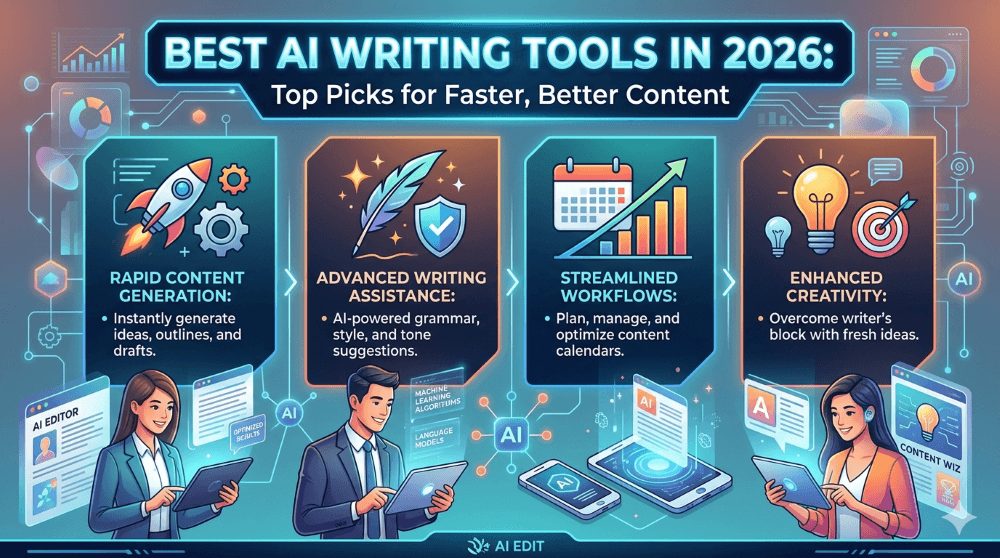
The Best AI Writing Tools: A Comprehensive Guide to Enhancing Content Creation
Quick Answer: The best AI writing tools help you draft blog posts, ads, emails, and social media content faster while improving consistency and quality. To choose the right tool, compare output quality, editing controls, SEO features, collaboration options, and pricing before subscribing.
In This Article
- Sponsored
Tired of juggling ten tabs? ToolSuite bundles the AI workflow tools power users rely on — in one place.
Try ToolSuite Now
If you are comparing AI writing tools, the real challenge is not finding options—it is finding the tool that actually fits your workflow. Some tools are designed for long-form SEO content, others for marketing copy, while some focus on brand voice consistency, multilingual support, or rapid brainstorming. In this guide, we break down the best of these tools, how to evaluate them, and where they fit exactly within a real content creation workflow.
What Are AI Writing Tools?
AI writing tools are software products powered by Large Language Models (LLMs) and machine learning systems to generate, rewrite, summarize, expand, or optimize text. In practice, they can assist with everything from blog outlines and product descriptions to email campaigns, ad copy, and internal documentation. A successful tool does more than just produce text quickly; it helps you transition from a “blank page” to a usable draft with minimal friction.
These tools have become an absolute necessity because content teams face growing pressure to publish at high volumes and personalize content faster. According to a McKinsey report, generative AI could add trillions of dollars annually to the global economy, with content creation being one of the most immediate use cases. This does not mean every output from the machine is ready for immediate publication, but it does mean the productivity upside is entirely real when the tool is used correctly.
How They Work
Most AI writing tools rely on prompts, pre-made templates, or guided workflows. You provide the topic, target audience, tone of voice, or objective, and the model generates text based on patterns learned from massive datasets. Advanced tools add extra features such as: tone controls, brand identity memory, citation embedding, SEO suggestions, and collaborative editing.
Key Areas of Excellence
Writing first drafts for articles, landing pages, and newsletters.
Rewriting content to improve clarity, tone, or local translation.
Generating various formats of ads and captions for social media.
Summarizing research papers or meeting minutes.
Scaling up content production volume for teams and digital agencies.
How to Choose the Best AI Writing Tool
Your choice of tool should start from your actual needs, not from how long the feature list is. A solo creator, an SEO team, and a marketing department all require completely different functionalities. The right tool is the one that reduces editing time, raises text quality, and fits your budget.
Core Evaluation Criteria
Output Quality: Does the tool produce natural, accurate, and useful text?
Control: Can you guide the tone, structure, length, and style?
SEO Support (SEO): Does it help integrate keywords, headings, and understand search intent?
Brand Consistency: Can it learn your voice or reuse your approved messaging?
Collaboration: Is it suitable for team workflows, approval systems, and shared files?
Multilingual Support: Does it handle both Arabic and English efficiently?
Pricing: Does the value it provides justify its monthly cost based on your usage rate?
For example, if your team publishes weekly SEO articles, a tool like Jasper AI might be more useful than general chatbots because it is specifically designed for marketing and maintaining brand identity. On the other hand, if you need quick drafting with high flexibility, Writesonic is often a strong competitor thanks to its practical features for publishing and content generation.
When to Avoid Overbuying
Many teams pay for advanced features they never actually use. If you only need drafts occasionally, a lightweight writing assistant might be enough. However, if you require deep SEO strategies, team approvals, or multilingual publishing, advanced platforms become a logical choice. The secret lies in avoiding paying for enterprise-level complexities while your workflow is still simple.
Best Use Cases for Smart Writing Tools
AI tools are not a one-size-fits-all solution; their performance varies depending on the required task. A tool that excels at ad copy might be mediocre for long-form articles, and an assistant geared toward research might not be ideal for writing sales copy.
Blogs and SEO Content
In blog writing, powerful tools help you build outlines, expand paragraphs, and maintain topical relevance. They can speed up production spectacularly, but human editing remains essential for fact-checking, adding a touch of originality, and ensuring alignment with search intent. If your goal is to rank in search results, look for tools that support keyword integration and readability improvements.
Marketing and Ad Content
In performance-driven digital marketing, speed and variety matter more than long-form details. This is where tools like Copy.ai stand out, generating multiple angles for ads, product pages, or email subject lines. This saves hours of work by creating dozens of options that a human marketer can later refine.
Email and Sales Workflows
Sales teams use AI to draft outreach emails, follow-ups, and personalized messages. Tools in this field should help you stay concise, persuasive, and aligned with company identity. Their true value shines when you want to send personalized messages to a large number of clients without writing each one from scratch.
Multilingual Content
For teams working in both Arabic and English, the quality of multilingual content is a critical differentiator. Some tools excel in English but struggle with the nuances, tone, or idiomatic expressions of the Arabic language. If you publish in both languages, test the tool with real-world examples before adopting it. This is why many teams turn to AI directories to compare tools before making a decision.
Common Limitations and Risks
Even the best AI writing tools have flaws; they can invent information (hallucination), repeat themselves, or make the brand’s voice sound flat, repetitive, and devoid of personality. These risks double in sensitive sectors (such as medicine and law) because errors can lead to legal or regulatory issues.
Quality Control is Still an Obligatory Requirement
AI should be treated as a drafting assistant, not an authoritative reference. Always verify statistics, names, dates, and scientific claims. If the tool cites sources, ensure those sources are current and genuine. For sensitive content, human review is non-negotiable.
SEO and Originality Concerns
Search engines reward original and useful content, not automated, repetitive texts. If you rely entirely on AI without adding your expertise, real-world examples, and unique perspective, your content may not achieve the desired ranking. AI accelerates the process, but it does not replace the expert or the editor.
Privacy and Data Considerations
Before uploading any confidential information, review the tool’s data policy. Some platforms store prompts to improve their models, while others offer stronger privacy controls—something that is vital for agencies, legal teams, and businesses handling sensitive materials.
Practical Rule: Use AI to speed up the first 70% of the work, then rely on human expertise to perfect the remaining 30%.
Best AI Writing Tools to Try
Here is a selection of the top tools worth testing to improve the speed and quality of your content:
Jasper AI: A powerful tool for marketing teams that need tone-of-voice control, campaign management, and heavy content production.
Writesonic: A flexible and comprehensive choice for SEO articles, landing pages, and quick drafting with practical direct-publishing support.
Copy.ai: The best for sales and marketing text when you need to quickly generate multiple options and ad angles.
Notion AI: Excellent for teams that organize their work and projects inside Notion and want a smart assistant right within their documents.
Grammarly: An exceptional tool for editing, proofreading, and improving clarity and tone rather than building full content from scratch.
Rytr: An economical and budget-friendly choice for simple tasks, quick drafts, and lightweight workflows.
Wordtune: A fantastic tool for sentence rewriting, improving text flow, and making copy sound more natural and professional.
If you are building a tool stack for content, combining them is common practice; you can write the first draft using Writesonic, polish the tone and style via Grammarly, and save the final version in Notion AI to collaborate with your team.
Discover AI Tools on DaleelAI
If you want to compare the best writing and productivity tools in one place, DaleelAI makes the process easier for you. You can explore the following tools based on your writing and editing needs:
| Tool | Primary Use Case | Tool Link |
|---|---|---|
| Jasper AI | An excellent platform for marketing teams, brand voice consistency, and high-volume content creation. | Browse Jasper AI |
| Writesonic | A flexible, smart writer for SEO articles, landing pages, and rapid text generation. | Browse Writesonic |
| Copy.ai | A robust choice for sales copy, email sequences, and heavy marketing variation. | Browse Copy.ai |
| Grammarly | An all-in-one editing assistant to improve grammar, clarity, tone, and readability. | Browse Grammarly |
| Notion AI | An embedded writing assistant focused on productivity, content management, and team knowledge. | Browse Notion AI |
| Wordtune | An outstanding rewriting tool that helps refine sentences and improve text fluidity. | Browse Wordtune |
| Rytr | An affordable, budget-friendly writer for quick drafts and basic content tasks. | Browse Rytr |
Conclusion & Summary
AI writing tools save time, but professional results still require a human editing touch.
Choose your tool based on your actual workflow specialty: whether it is SEO, ads, email, teamwork, or multilingual content.
Test the output quality, control capabilities, and privacy policies before committing to a paid subscription.
For businesses and teams, collaboration features and maintaining a unified tone of voice outweigh the importance of raw, automated generation speed.
AI content writing is no longer about replacing writers; it aims to help teams produce much better drafts with less time and lower effort. If you are looking for a reliable platform to compare tools and discover more tech products across various categories, visit DaleelAI, the comprehensive directory for finding the AI tool that perfectly matches your needs.



Comments
0No comments yet.
Please log in to comment.
Comments are available for members only. Sign in to participate in the discussion, or create a new account for free.