

Open this AI tool now
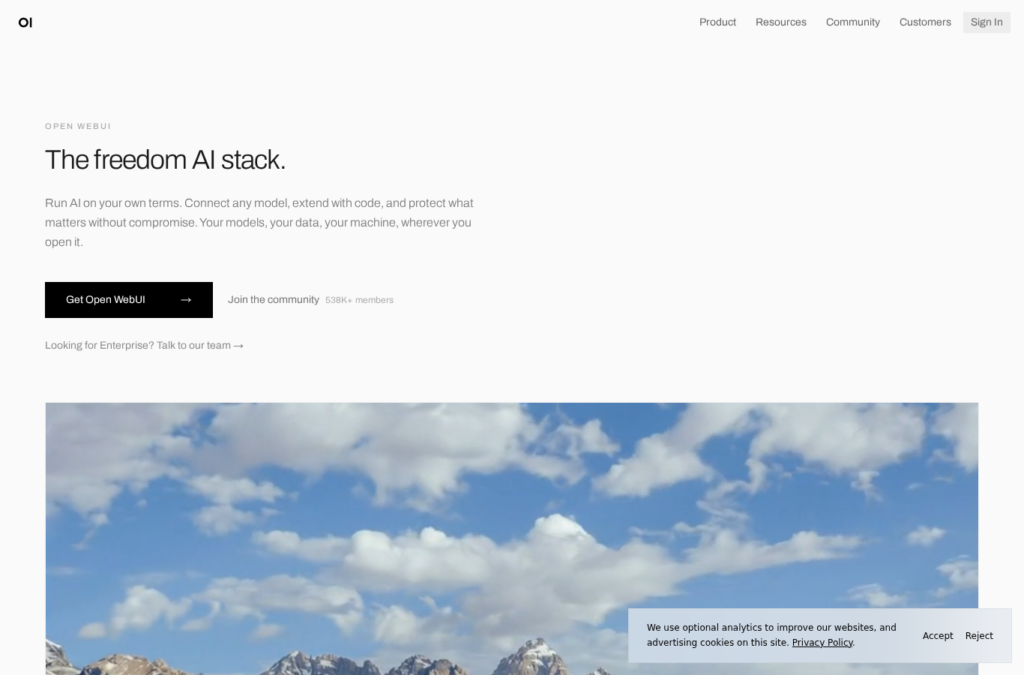
https://openwebui.com/The Verdict: Open WebUI suits technical teams and self-hosters who want a private, multi-user AI workspace connecting local runtimes to cloud APIs. Skip it if you need a zero-configuration desktop app without dealing with Docker, container networking, or server administration.
Multi-Model Flexibility and Local Knowledge
Created by Timothy Jaeryang Baek and maintained by Open WebUI Inc., the platform operates as a self-hosted AI interface built to run entirely offline. It connects directly to Ollama, vLLM, OpenAI, or Anthropic. While dedicated desktop clients like LM Studio and Jan serve individual machines, Open WebUI delivers centralized multi-user administration with single sign-on, LDAP/AD, and role-based permissions.
Tired of juggling ten tabs? ToolSuite bundles the AI workflow tools power users rely on — in one place.
Try ToolSuite NowFor document retrieval, it rivals tools like AnythingLLM. Organizations can chat with your PDFs locally, sync files via oikb from GitHub, S3, or Confluence, and connect Model Context Protocol (MCP) servers via stdio or the mcpo proxy.
The 50-User Branding Clause and Pricing
Standard deployment is free, but Open WebUI does not use an OSI-approved open-source license. Its custom BSD-style license contains an explicit branding restriction: you cannot remove or alter the Open WebUI brand unless you maintain 50 or fewer rolling 30-day active users, secure written permission, or buy an Enterprise License.
Deployments with the original branding intact cost nothing. However, companies requiring white-labeling, multi-user Terminals, organizational Tether access, or support must contact sales from a work email with their expected number of end users. Enterprise licences are sold only to registered organisations, and there is no public price list.
Sandboxed Terminals and Desktop Tethering
Open WebUI expands beyond standard chat through Open Terminal, offering models a free, sandboxed Linux shell with code execution, file management, and live previews. Coding agents including Codex, Claude Code, Cursor, and Gemini CLI can run inside it. Furthermore, the Tether desktop client connects personal computers running local models back to Open WebUI without firewall reconfiguration, locking filesystem access to a chosen directory on macOS and supported Windows machines.
Arabic Language Support and Verification
The project codebase contains two community-translated Arabic locales: standard Arabic (ar) and Arabic (Bahrain) (ar-BH). However, translation completeness and right-to-left (RTL) layout quality are undocumented, and the vendor website lacks an Arabic page. Arabic answer quality depends on your chosen backend model rather than the interface.
Run this practical checklist before adopting it for Arabic workflows:
- Switch the user interface to Arabic (ar or ar-BH) to examine navigation and menu layouts.
- Upload an Arabic PDF to test document parsing and retrieval accuracy.
- Submit queries in both Modern Standard Arabic and regional spoken dialects.
- Evaluate right-to-left rendering for bidirectional text containing mixed Arabic and English phrases.
Deployment and Resource Footprint
The latest release, v0.13.4 (17 November 2026), adds local MCP servers over stdio and the Tether folder sandbox. Open WebUI installs via pip, uvx on Python 3.12, Kubernetes Helm charts, or Docker on port 8080. Although official minimum hardware specifications are not provided, developers offer a 197 MB slim Docker image alongside the 1.62 GB default build. In testing on 16 October 2026, the slim container used around 300 MiB of idle RAM. Treat that as a guide, not an official minimum.
Arabic support
Open WebUI ships two Arabic interface locales (ar and ar-BH), community-translated and covering about three quarters of the strings, so some labels stay English. RTL layout quality is undocumented, and Arabic understanding depends on the model you connect.
- Arabic interface (right-to-left)Partly
- Understands and writes ArabicNot verified yet
- Dialects (Gulf, Egyptian, Levantine)Not verified yet
- Reads Arabic in images and PDFsNot verified yet
- Arabic speechNot verified yet
Daleel check
What our team checked on 20 Nov 2026
- Read the home, docs, enterprise and licence pages
- Counted translated strings in the Arabic locale file on GitHub
- Read the v0.13.4 release notes
- Loaded the site with an Arabic browser language: it stayed English
- Did not install the platform or try a model in Arabic
Verdict: The strongest free option for running a self-hosted AI chat platform for a whole team, with a partly translated Arabic interface. Mind the branding clause above 50 users, and test Arabic with the model you plan to use.
Questions about Open WebUI
No questions yet. Ask the first one.
Do you make Open WebUI? Add the DaleelAI badge to your site
Copy the code and paste it into your site’s footer or press page. It links to this page, so visitors can read about your tool in Arabic and English.














Comments
0No comments yet.
Please log in to comment.
Comments are available for members only. Sign in to participate in the discussion, or create a new account for free.